Tuesday, 14 June 2011

The Bird in ICU

Hi Folks,

I have so far been telling stories of my past experiences on the blog. But today’s story is the latest adventure, just for a change.

For the past two days, we have been hearing the crying sound of some bird from a nearby mango tree. The sound was more prominent during night, indicating some distress call from a bird.

This morning we located the bird. It was a big owl sitting on a low branch and its chick was lying on the ground, alive but apparently with some injuries. The flock of other varieties of birds (which we have many in our house garden), were hovering around as usual, feeding on the grain provided every morning by us.  But the chirping was unusually louder & more shrill today.

While my wife and I were discussing what should be done to save this chick, suddenly the chick flew up & sat on the railing of our boundary wall, very close to where we were standing. Meanwhile, our house-help had brought back our two dogs after their morning walk.  The chick got frightened by the barking dogs and fell over on the other side of the wall.

My wife quickly went to the other side with a small towel, wrapped the chick & brought it into the house. The chick was injured and bleeding from one of its wings and also had some bruises on the body.


                                              (Below is a photo of the Patient)


Our family Vet happened to be out of town but told us what to do on the phone. Accordingly, as advised, the wounds were cleaned with antiseptic solution, betadine ointment applied and powder from the terramycine capsule diluted and given to the chick with a dropper - just 6 drops, no more and no less, at an interval of exactly 4 hours...


Its 14 hours now and the chick is recovering fast. Hopefully, it will be discharged from our care tomorrow evening.

                                         The patient in the caring hands of Usha Singh (my wife)


Below-Me & Patient

A word about the birds in our garden. As I said they are of various species and we don’t know their names. But does that really matter?  We believe what Richard Feynman has said:-


“You can know the name of a bird in all the languages of the world, but when you’re finished, you’ll know absolutely nothing whatever about the birds......So let’s look at the bird and see what its doing- that’s what counts. I learned very early the difference between knowing the name of some thing and knowing some thing”

My house in Dehradun, India is adjacent to a huge forest. It is protected forest and managed by the Forest Institute, one of the oldest and the largest institute in Asia. It is also therefore the home of many Himalayan birds, who also spill over to our house.  Lastly, I am told, this chick falls under the category of “endangered species."                                                       


Below is a photo of the Forest belonging to the Forest Research Institute of India located                              just behind my house

(My house, garden & trees)


Monday, 13 June 2011

Grand trunk road kabul to Bengal,Mughals, Sher Shah Sur, Chandragupta Maurya

The Grand Trunk Road:

The picture below was taken in 1984 during my visit to Taxila in Pakistan. It shows part of Grand trunk Road, which is one of South Asia’s longest and oldest roads stretching between Kabul in the west and Bengal in the east. The Information board near the road describes that the road was built by the Mughal kings- though there is no evidence or account given by any historian to this effect. However, given that Pakistan’s history has been systematically and deliberately re-written over the last 30 or so years to meet very particular religious and political ends, it is perhaps not surprising that the road’s history was fabricated on this official board as well.

Not withstanding the false information provided here, it did amuse my 3 year old son (standing near the board) to no end that “from” was incorrectly spelt as “form”. We had to make him quiet by saying that “the Mother tongue in Pakistan is Urdu & not English”.


In India, we were taught in history classes that this road was built by an Afghan king, Sher Shah Sur, who ruled India in 1500 A.D. I am, however, not fully convinced with this claim either.

First, let us take the evidence supplied by numerous  Indian historians who have given accounts of the advent of  Sher Shah Sur rule in India according to which, Sur, also known as Suri or Sher Khan, was an Afghan noble who annexed Southern Bihar & Bengal from Humayun (son of first Mughal king Babur) in 1539. By 1540, he had defeated the opium addicted Mughal king who had  run away to Lahore and then to Kabul, finally taking refuse with Shah Tahmasp, the Safavid ruler  in Iran. Humayun remained in exile for 15 years

However, Sher Shah Suri alias Sher Khan ruled Northern India only for 5 years from 1540 to 1545. On his death, the throne at Delhi passed to his son Islam Shah Sur, who in the course of 8 years reign was not able to consolidate his centralised rule. On the death of Islam Shah  in 1553, the Sur domains were divided by treaty into the Punjab, Agra & Delhi, Bihar with some Eastern Region & Bengal. Each domain was ruled by a son or relative of Sher Shah Sur. The decline soon started & thus, Humayun who had reorganised his army by then was able to regain the lost territory by mid 1555.


Thus, given the extraordinarily short period of his reign, the theory that this grand length of road was built by Sher Shah Sur, seems fairly unlikely and does not really hold ground.

 So who actually built this road?


Those of us who have read the history of Ancient India will remember that the Maurian dynasty started by Chandragupta Maurya in 321 B.C., had acquired and united most of the sub- continent under a single empire, and after the defeat of  the Greek Seleucus Nikator, even the trans- Indus provinces (which today would cover part of Afghanistan) formed part of its vast territories.

Chandragupta Maurya’s son, Bindusar and his grand son, Ashoka further expended the empire. In 260 B.C. Ashoka managed to defeat the most powerful king of Kalinga, after which all other kings of South India also accepted his authority. Ashoka’s son Mahindra in his turn extended the mauryan influence all the way up to Ceylon

Historians also confirm that Ashoka maintained friendly relations with his contemporaries in the Hellenic world with whom he exchanged diplomatic and trade relations. The most prominent amongst them were Antiochus II Theos of Syria (260-246 B.C.), the grandson of Seleucus Nikatoe, Ptolemy III Philadelphus of Egypt (285-247 B.C.); Antigonus Gonatus of Macedonia (276-239B.C.), Megas of Cyrene, and Alexander of Epirus. Communications with the outside world were by now well developed. As a result, there was regular movement of people from Bengal to North West provinces and further towards West Asia for trade, pilgrimage, education etc. The Chief Advisor of Chandragupta Maurya, Kautalya (also known as Chanakya) himself was from Taxila University who regularly travelled between Taxila & Magadh.

Therefore, one can conclude beyond doubt that there had existed some sort of an artery between what is now eastern Bengal & western Kabul even in ancient times. This suggests that rather than necessarily building the road medieval and modern kings probably just repaired and/or realigned portions of it.

Thursday, 9 June 2011

Oldest Indian Mountain Batteries (Frontier Force) and Evolution of Mountain Guns

4th HAZARA MOUNTAIN BATTERY FRONTIER FORCE

This Battery too, like the 1st to 3rd, was raised from the disbanded artillerymen of Sikh Army of Maharaja Ranjit Singh. The Battery was raised at Haripur in 1851 and trained by Major Abbot to help the British Army defend the Hazara district of the North West Frontier. More details of this Battery can be found in my earlier posts. 

5th BOMBAY MOUNTAIN BATTERY:-

Raised in 1827 as Bombay Foot Artillery, the 5th is the oldest Indian Mountain Battery. Ironically, the battery was used by the British against the forces of Maharaja Ranjit Singh in the Second Sikh War at the siege of Multan in 1849. The Battery was the first to serve outside India when it took part in Abyssinia Expedition in 1867-68.

It did not play a role in the Second Afghan War but took part in the war with Burma from 1885-87.

In the year 1896, the Battery was back in Africa and deployed in Sudan. In 1897 it came back to the Frontier and served in the Second Division of the Tirah Field Force. During the First World War, the 5th served on the Frontier, the Persian Seiten Cordon in 1917 and during the last mopping up operations in Mesopotamia in 1917-1918.

Later, the Battery saw action in the war against the Fakir of Ipi in Waziristan in late 1930’s. It is worth pointing out, that unlike the 1st to 4th Mountain Batteries which were raised out of the disbanded Artillerymen of the Sikh Forces, the 5th never been part of Punjab Frontier Force.

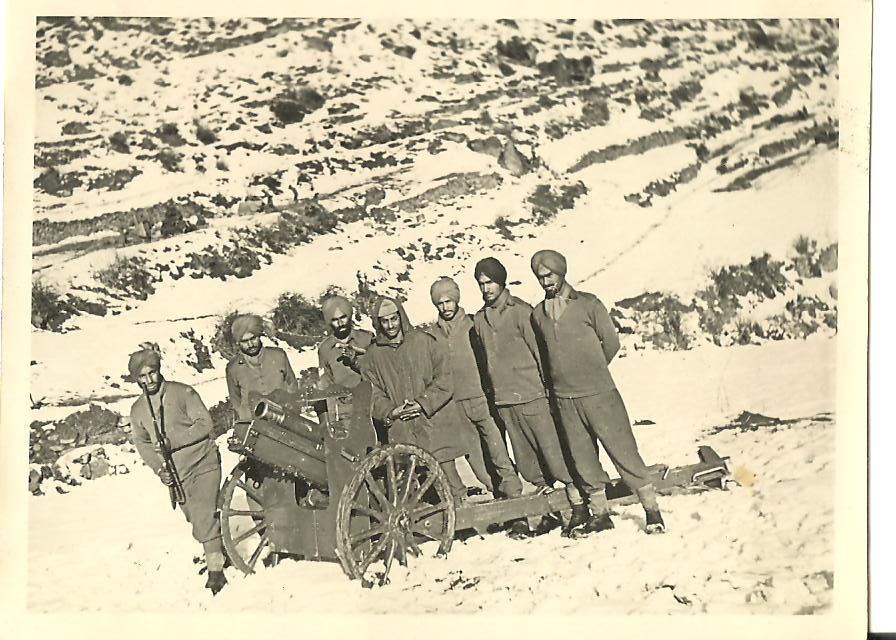
Picture below is of 3.7 Inch Howitzer Mountain Gun deployed in a snow bound operational location
                               ( Me, the then Gun Position Officer (GPO) standing in the center)


THE EVOLUTION OF MOUNTAIN GUNS:-

Before I conclude my article on the Indian Mountain Batteries, a few lines about the need of maintaining Mountain artillery & also the gradual developments of its guns, seem imperative to visualise their importance in battles.

The guns with the Mountain Batteries used to be light in calibre & designed in such a way that they could be dismantled into eight parts, carried on well trained mules to difficult mountain terrains, and deployed at designated gun positions after quick assembling.

The record time for dismantling or re-assembling a gun used to be between 45 to 50 seconds. The mules used to be known as “Mules MA” i.e. Mules Mountain Artillery, well built and much taller in comparison to "Mules GS" (General Service).

Each mule was designated to carry a particular part of the gun and accordingly, numbered as No1, 2, 3, & so on. The saddle for each mule was specially designed to enable the animal to trot, canter or gallop without dropping or damaging the load.

Like soldiers, the mules also had to under go vigorous training and therefore, their discipline and devotion to duty used to be unerring & beyond doubt; they were ready to serve, always and every where. The mules of each gun detachment would follow the lead mule (Mule No.1), maintaining their positions in sequence and once unloaded & the gun brought in action, they would remain completely still and silent. 


The picture below shows my 2nd (Derajat) Mountain Battery (FF) moving to operational area in 1963
   

The earliest guns were the tiny 3 Pounder SBML (Smooth Bore Muzzle Loading) and 4.2/5 Inch SBML Howitzer of 1850 vintage. These were replaced in 1865 by the 7 Pounder RML (Rifle Muzzle Loading). In 1879, this too was replaced by the significantly improved and heavier 2.5 Inch RML – also known as Kipling’s Screw Gun. The advantage of this gun ( and all later versions) was that its barrel could be split in two for easier transportation.

During the Great War (First World War), all the Mountain Batteries were equipped with 10 Pounder BL or 2.75 Inch RML guns. It was only  in the last year of the war that the next model, the 3.7 Inch Howitzer, was introduced in East Africa, and proved to be far superior to the previous models. This continued as standard mountain gun during the inter-war years and throughout World War-II, and later on until 1965-66.

Below picture is of my OP (Observation Post) team at forward location. Me in the centre with my two TAs                      (Technical assistants)

Tuesday, 7 June 2011

Indian Mountain Artillery, Peshawar Battery

Hi Folks,
Here is a brief history of the 3rd Indian Mountain Battery.

3rd PESHAWAR MOUNTAIN BATTERY FRONTIER FORCE:-

This Battery too, was raised out of the disbanded artillerymen of the  Maharaja Ranjit Singh, at Peshawar in 1853. Soon thereafter, it took part in numerous Frontier campaigns including  the most brutal Ambala campaign in 1863.

From 1871 to February 1872, the Battery took part in Looshai campaign, far across on the other side of India. During the Second Afghan War, the 3rd saw action  at Kandhar in 1878.

During the First World War,  this was one of the two original Mountain Batteries to land in Mesopotamia in late 1914, where it remained till 1917 and then returned to India to take part in the Third Afghan War, in the   Waziristan campaigns in 1929 and 1930.

After India’s partition in 1947, when the process of the division of assets of the defence forces took place, this Battery was handed over to the  Pakistan Army.

Below is a picture taken in 1883, where an Indian Mountain Battery is ready to move for action

Another photograph (below) is of an old 2.75 inch Mountain Gun


Friday, 3 June 2011

Indian Mountain Artillery: the Kohat & Derajat Batteries

Brief History of the first Five Indian Mountain Batteries

1st(KOHAT) MOUNTAIN BATTERY FRONTIER FORCE:-

This premier Indian mountain battery was raised at Bannu in 1851 from the Sikh artillerymen following the second Sikh War of 1849. The Battery saw action in the Frontier area during the first war of Independence  in 1847. (Sadly many Indian historians still call it Indian Mutiny) and in subsequent battles through out the 19th century.

During the Second Afghan War of 1878-80, it was deployed at Peiwar Kotal and saw heavy action at Kabul.
In the early stages of the First World War, the Battery helped defend Egypt from Turkish aggression and soon thereafter, landed at Gallipoli where it supported the Australians and New Zealanders in the fighting and the subsequent pull out. Later the Battery was sent to Mesopotamia & Persia till the war ended.

During the inter-war years, it was deployed in Waziristan in early 1920’s and again in late 30’s. After India’s independence & partition of the country, the Battery was transferred to Pakistan.

2nd (DERAJAT) MOUNTAIN BATTERY FRONTIER FORCE:-

This Battery, like the 1st kohat, was also raised from the disbanded Sikh artillerymen. However, it was raised two years earlier, in 1849 at Dera Ghazi Khan. During the 1857 Rebellion, its one detachment was deployed at Oudh and Bundelkhand

During the Second Afghan war of 1878-80, it remained deployed at Peirwar Kotal and Charasia to defend Kabul and then moved to the south of Kandhar, undertaking that most famous march. Later, in 1895, the Battery took part in battles at Chitral and participated in operations of the Tirah Field Force.

During the First World War, in 1916,  the 2D (its nick-name) joined campaign against Colonel Von-Lettow-Vorbeck in German East Africa until the armistice.

Later on, the Battery took part in the Third Afghan War in 1919, the Mohmand Campaigns of 1933 and 1935, and operations in Wazirstan against the Fakir of Ipi from 1936 on.

This was the Battery where I had the proud privilege to serve in early 1960’s. With the modernisation of the Indian Army and its guns; the 2-D is no more a Mountain Battery but has become a Field Battery.


Before Second World War, the Mountain Batteries were equipped with various kinds of guns.The picture above shows a Mountain Battery in action with six of its 7 Pounder guns in ready position.

Tuesday, 31 May 2011

Indian army, Artillery, oldest mountain batteries

30 May, 2011

My Army Days

Coming back to Indian Mountain Artillery once again as promised in  my  previous blogs, it is interesting to know the historical back ground under which these oldest five Mountain  Batteries were  raised and deployed.

As we know, the frontier area in the extreme West side of the then undivided India was - and still is - the home of mixed tribes who always believed in their own rules and tribal ways of administration. They never reconciled to the Mughal rule over their territory and kept asserting for independence. In the years after the Mughal rule, Maharaja Ranjit Singh of Punjab, using his Zum Zum guns and cavalry, established control over the whole of the Frontier area. His empire thus included not only Punjab but also what today is Pakistan, POK (Pakistan Occupied Kashmir), and Jammu & Kashmir.

Later, when the British Raj took root in India, their Governor General Dalhousie, could not resist the temptation to extend British control further West. Taking into account that Ranjit Singh was already crippled by two paralytic strokes, Dalhousie, in October 1848, declared war against the Maharaja. By March 1849, after a series of battles, the Sikh Army finally surrendered and Punjab Empire was annexed outright by the British.

Soon after the annexation,  the British Army  raised four new Mountain Artillery Batteries in which most of the Indian Gunners from the disbanded Artillery units of Ranjit Singh were re-recruited. These  four Batteries were initially known as Punjab Frontier Force (PFF) Batteries & designated as:-

Ist Kohat Mountain Battery (PFF).
2nd Derajat Mountain Battery (PFF)
3rd Peshawar Mountain Battery (PFF) and
4th Hazara Mountain Battery (PFF)  

Incidentally, the 5th Bombay Mountain Battery had been raised much earlier in 1827 as the Bombay Foot Artillery as is the oldest Indian Mountain Battery. It was however, never part of PFF.

A brief account of each battery to follow in my subsequent blog posts.

Thursday, 26 May 2011

Dehradun,India,Bollywood,villains, Indian religions


23 May,2011-05-23
Villains in Bollywood

Last Wednesday evening, we visited the DSOI club (Defence Services Officers Institute) Dehradun as usual. The club is located in the cantonment area, just a kilometre away from my residence.

The vast open area around the club includes the golf course, helipads, etc, as well as the panoramic view of the great Himalayas.  The lights of Mussoorie twinkling in the distance provide a fascinating touch to the place at night.

We often go there to enjoy the serene environment and spend time with old friends and colleagues, discussing everything on the earth, from our youthful days in the Army to the old age aliments.  

Wednesdays, however, are special, particularly for families and children since a movie is shown on that day.  Movie-watching at the club is casual, homely and absolutely relaxed, with regular flow of people between the hall where films are shown and the bar/food counters located in the near-by rooms. In summers, food counters and bar are moved to the lawn outside the hall to cater for larger gatherings.


                                   (View of Himaliyan mountains from the DSOI club, Dehradun)


                                            (A closure view of picture one above)

This last Wednesday, we went to watch the movie of the week.  I do not remember the name but it was one of those Bollywood  films where a powerful, rich, but cruel village headman carries out atrocities on the poor villagers, and in the end (as expected) is killed by the hero (with the help of the village belle).

After the film, we came home but some how the name of the villain kept returning to my thoughts. His name was “some…Singh.” While I lay in bed, I kept recollecting the names of various villains in movies I have seen over the past 60 years. Astonishingly the majority of names that I could recollect bore the surname Singh, the most famous of course being Gabbar Singh of Sholay.

I wonder why Bollywood is so obsessed with the surname Singh, and why it chooses to mostly give it to the bad guys?

Historically, of course, the surname Singh has been synonymous with Kshatriyas, who have, since time immemorial, bravely fought and sacrificed their lives for defending and preserving the state and/or kingdom, and protecting the people.

I suppose the irony is that while Bollywood projects the Singhs as villains, it does not realise that all major Indian religions were started by Kshatriyas:

Lord Ram, a Kshatriya king of Ayodhya, is revered by all Hindus;
Siddharth, a Kshatriya prince of Kapilvastu (just 30-40 kms north of district Gorakhpur in Uttar Pradesh) started Buddhism;
Mahavir, another Kshatriya laid the foundation of Jainism in Bihar;
Even Guru Nanak Devji who started Sikhism was also a Kshatriya.