My keenness to watch the ceremony had no particular reason. It was not because I have any personal equation with William or Kate, or was enthusiastic to know how a wedding takes place (I have been married for the last 44 years & live happily with my better half). But I like to see people happy and making merry at the slightest given opportunity. And I like smiling faces and bright eyes.
The best part of the ceremony for me was when the royal couple drove to the Buckingham palace in a four horse driven carriage, guarded by mounted horsemen. I did cheer (with a bottoms up of my beer mug) when I saw William in his full Air Force ceremonial uniform, prominently displaying the medals and the pilot wings on his chest. My instant thought: I wish one would see some children of Indian Ex-Royals, politicians and industrialists wearing the military uniform and serving tenure at places like Saichen glacier or the Rajasthan desert.
Watching the horse and carriage parade, the royal wedding also reminded me of my Mountain Artillery days:
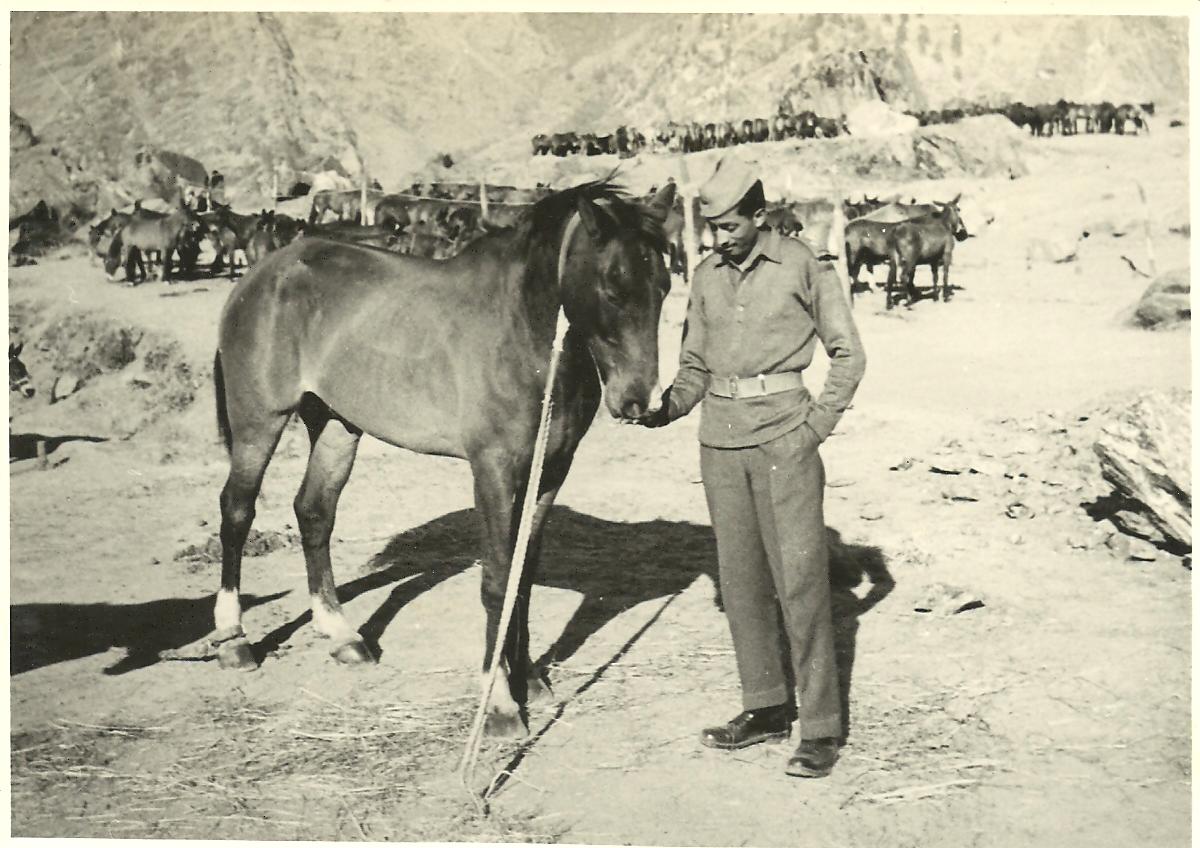
The year was 1963 and our Mountain Artillery Regiment had just returned to a peace station after taking part in the 1962 Indo-China war in Arunachal Pradesh, then known as North East Frontier Agency (NEFA).
The Regiment (Regt) was allotted a large open area on the outskirts of the Cantonment (Cantt), which in itself was located beyond the main township. The offices, Quarter guard and the Officers mess were set up close to a dirt road that led to the Cantt area and to the town beyond, while the Regimental Hqrs. and the four Batteries were allotted areas further inside the perimeter where soldiers, horses, mules, guns, saddles and other equipments etc. were soon established. There was no constructed accommodation in the area and therefore every thing was under tents and large tarpaulin sheds erected by the troops.
Regular peace time routine of the unit soon started. It is essential to clarify here that unlike other branches of the Army, where the day starts with PT (Physical Training), followed by Drill with & without arms etc, the Mountain Artillery starts the day with horse/mule riding, cleaning and feeding of the animals, followed by vigorous gun drills etc. Accordingly, the officers got in to the routine of riding around the cantonment on their respective chargers (horse allotted to a particular officer is known as his charger). The other units in the Cantonment soon felt our presence as we often trotted by, passing others units’ PT squads, waving and exchanging greetings.
Months passed and we settled down in our routine. The senior officers of the Regiment were soon joined by their families as they were senior enough to be allotted family accommodations at a peace station. The rest of young bachelor officers joined the local Defence club and in due course virtually took it over for regular evening parties - drinking, singing and dancing, in short, enjoying all the benefits of a peace station. Our friend circle, both amongst the civilians and local Army units, also swelled gradually.
The days passed and winter approached. Then one evening, Major Raghu Nath Kapoor of a nearby Signals Battalion came to our Officers’ Mess and invited us all to attend his wedding, which was due to take place next month. After few more meetings, Major Kapoor, one day, made a request to our Commanding Officer (CO). He asked if some of us could come to the wedding reception on horseback as it would add more glamour and uniqueness to his party and impress the bride and her family. He also told us that the bridegroom’s party would be assembling at a guest- house hardly three kilometres from our Unit lines and located only about 400 meters from the bride’s house. The proposition looked simple enough and accordingly, on our CO’s nod, it was decided that we would all go to the guest-house on horseback, join the rest of the marriage party, and lead the procession up to bride’s house for the grand arrival of the baraat.
From there, we would quickly gallop back to our Officer’s Mess. Since our batmen (a soldier is attached to each officer who looks after his administrative requirements) would keep our dress clothes ready, we would quickly change into suits and tie, hop into a one-ton vehicle and re-join the wedding party at the bride’s house for the rest of the function. The timings for the whole procession were worked out by the senior captains who estimated that the whole operation would just take 30-35 minutes at the most and no-one would notice our short absence at the function.
For the bachelors, this was the first major civilian function where we were invited after arriving at a peace station. Hence, our preparations were also soon in full - if discreet - swing. Some of the senior officers, who had been able to replenish their wardrobes with civilian clothes, took out their suits, shirts and ties for drycleaning. But most of us, who had nothing except our army uniforms, had to rush into town to get new suits made. The troops in charge of the animals were specifically instructed to ensure extra grooming and care of our respective horses. Saddles had to be cleaned and brass items polished extra bright. The young officers were extra-enthusiastic, as on such occasions, female turnout was expected in reasonably good numbers, and no doubt there would be opportunities to develop new friendships.
The month period passed quickly and on D-Day, we were all ready, in our well-ironed breeches, riding boots, blazers with Regimental scarves and pith hats by 6:30 pm. Our horses had already been brought to the Officers Mess from our respective Batteries. Once ready, we eight officers proceeded towards the first venue, the guesthouse, on horseback, followed four soldiers (horsemen) on their mounts who were assigned to take care of all the horses once we dismounted.
The scene at the guest house was jubilant and festive. The building was well decorated, and lit with coloured lights and flowers. Most of the guests had already arrived. A local army brass band from an Infantry Regimental Centre was already in attendance, playing some old favourite tunes. Children, of various age groups in their bright new outfits, were running here and there, playing, shouting, singing as is usually their wont.
Major Kapoor was in his ceremonial wedding attire, sitting in the veranda, surrounded by his family members and friends. A white (although in equestrian terminology, it is grey), ill fed mare was also standing by with her attendant. She was the hired mare from the town, exclusively trained and used for carrying bridegrooms in the wedding processions. These mares are trained not to exert themselves and just amble along in the procession, halting every 10-15 steps. Thus they are considered very safe and docile and can be ridden by anyone.
Around 7:30, there was an announcement made by some one (probably by the bridegroom’s father) that the wedding procession was ready to march to the bride’s house. At that very moment, Major Kapoor and some of his friend and relatives decided that it would be good idea if the groom also rode a better-looking horse instead of the poor, locally hired, mare; it would be a better style for a bridegroom who was an army officer!
For us, it was again a simple enough request and, within no time, one of our soldier- horsemen was told to dismount and Major Kapoor mounted on his horse. (Mind you, though the request looked very simple but it was so since Kapoor too was an army officer. We could not have agreed to a similar request from a civilian as it would have amounted to misuse of defence property by unauthorised person. Hahahaha!)
The procession started, with Major Kapoor surrounded by us, all on horseback. The procession reached the bride’s house, covering the 400 metres in about half an hour, with the people singing and dancing all along the route, and soon the initial religious welcoming ceremonies started.
This was the moment when our senior Captain winked at us, and as per plan, we all jumped on our horses and galloped off for our unit lines, to quickly change and return. Within fifteen minutes we were back at our mess, and were rushing to our tents for a quick wash & change when some noise and commotion were heard.
Stepping out, we saw: what a catastrophe!
The horse that Major Kapoor was riding had fled the venue too, bringing the rider with him!
Being a horseholder’s mount, it was trained to follow the leader and neither dared to lead the herd nor part with it. So it had taken off after us before Major Kapoor could dismount, but had trailed behind with the result we had not seen it during our charge back to the mess. Major Kapoor was glued to the saddle by all his fours limbs, like a baby monkey clinging to its mother. He was pale and speechless. (Too bad Fevicol was not around then, as it would make the perfect ad!)
We all realised that something had to be done immediately, not withstanding that we could not decide whether to laugh or cry at the situation.
The senior captain quickly assessed the situation and took control of the operation. He instructed that the Major Sahib be taken off the horse and be put in the anteroom of the Officer’s Mess comfortably with some drinks to cool his nerves. (The Mess anteroom was in a large tent while another large tent attached to it functioned as the bar-cum-dining area.)
Meanwhile, the junior most subaltern, who was detailed as the “Duty Officer of the Day” was summoned and instructed to ride to the bride’s house and inform about the major’s well being. Meanwhile, we all quickly changed into our suits and soon everyone, including Major Kapoor, hopped into the waiting one-ton truck and sped off to the wedding.
There was a sigh of great relief when Major Kapoor arrive without harm, and the dictum of “All is well that ends well” prevailed!
PS: Next day at the Regimental Hqrs., we all were marched in to our CO where we were asked to narrate the whole episode to him in detail. The Second-in-Command of the Regiment carried out a thorough postmortem of the operation, and the following orders were issued for implementation with immediate effect:
(a) No outsider (including defence personnel) would be allowed to ride Regimental horses without exclusive permission of the CO;
(b) Cantonment Board was to be approached to get a temporary telephone line laid between the Unit Telephone Exchange and the Civil Telephone Exchange for urgent operational needs. (This was done since the Duty Officer was unable to get his call through to the wedding as he had to get the connection via our unit exchange to the central Military exchange and then to the civil Exchange and eventually to the required number. There were no mobile sets then);
(c) An extra Ration Allowance for purchase of one kilogram of jaggery (Gur) for one week sanctioned to the horse (ridden by Major Kapoor) for its exemplary performance of duty in accordance with the training manual.